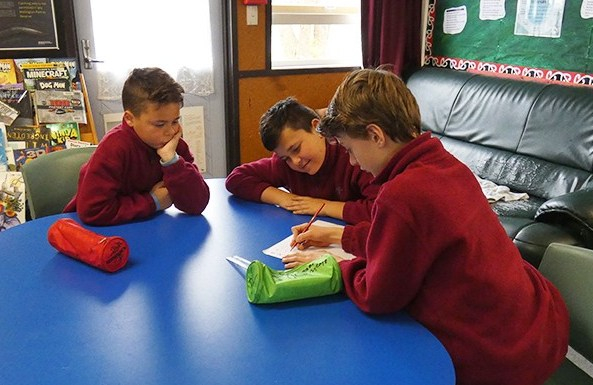
Wednesday this week was a particularly exciting day for me! I got to meet the student kaitiaki of Donald’s Creek and talk to them about their hopes and dreams for the stream. I had heard lots about the project already, of course, thanks to teacher Liz Lark and Zoe Studd (Mountains to Sea Wellington). However, I was now looking forward to get the “inside scoop” from the students themselves – and also to be able to dig a bit deeper.
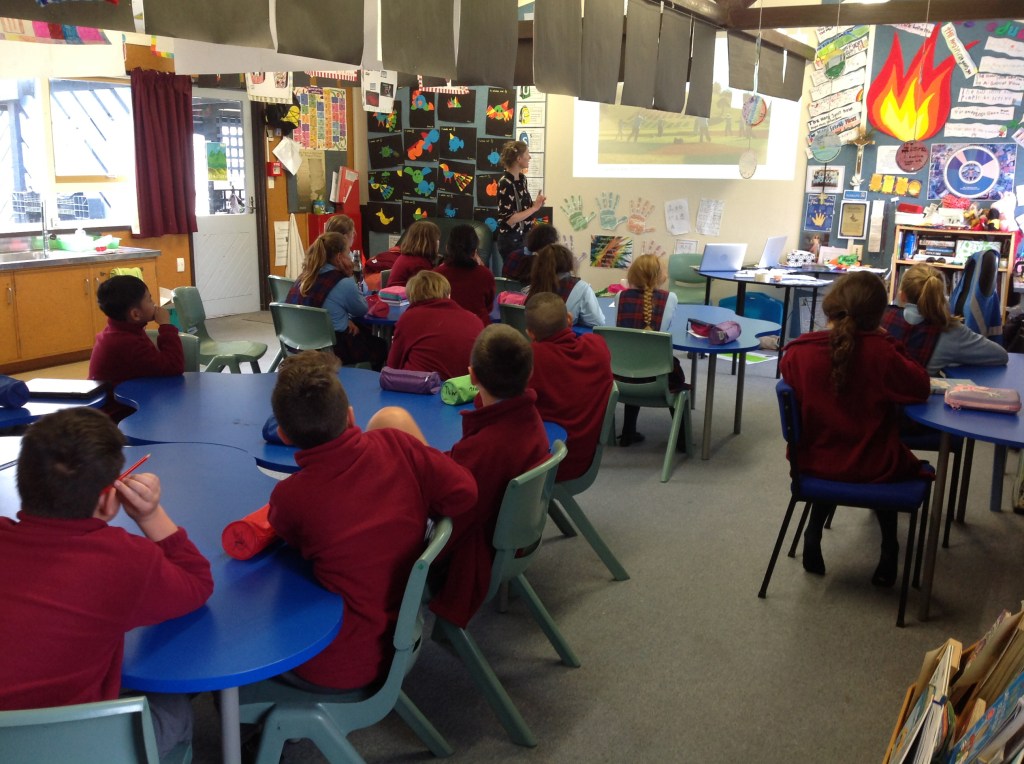
I am joining the project as a Creative Community Engagement Coordinator (CCEC) and part of my role will be to work together with the students to find ways to enable the community to engage with the project and stream, and to celebrate the great mahi of the student kaitiaki. So to give them a bit more of an idea of who I am and what I do before getting, we started the session with some slides from some recent projects that I have done, including Projected Fields, Open Air Life and taking part in WAI – Manga Maha, Awa Kotahi, One River, Many Streams, at Aratoi Wairarapa Museum of Art & History.
We also had a look at what’s been happening on this blog so far, so that they and their families know where to find it, and look out for updates. The students made me feel right at home and it was great to be able to talk to them about issues that we are all really interested in!
Hanging up in the class room were the brilliant restoration plans that the student kaitiaki had drawn out earlier in the project. I think I could easily have spent a whole day asking and finding out about their detailed drawings and what these represented. However school and student life is busy, so today I had only one hour, and I had come prepared with a bunch of questions and exercises to help me better understand what are some of the key ideas at stake for the students, and the experiences and dreams closest to their hearts.
When asked to work in groups and describe or list their favourite moments or experiences from the Donald’s Creek Restoration project so far, there was no shortage of insight or enthusiasm. From the great variety of responses it was obvious that through this project, all the students have been able to do or learn about something that was completely new to them – and equally, all of them have thoroughly enjoyed the monitoring of the stream and learning about fish, and especially eels and macro-invertebrates living there.
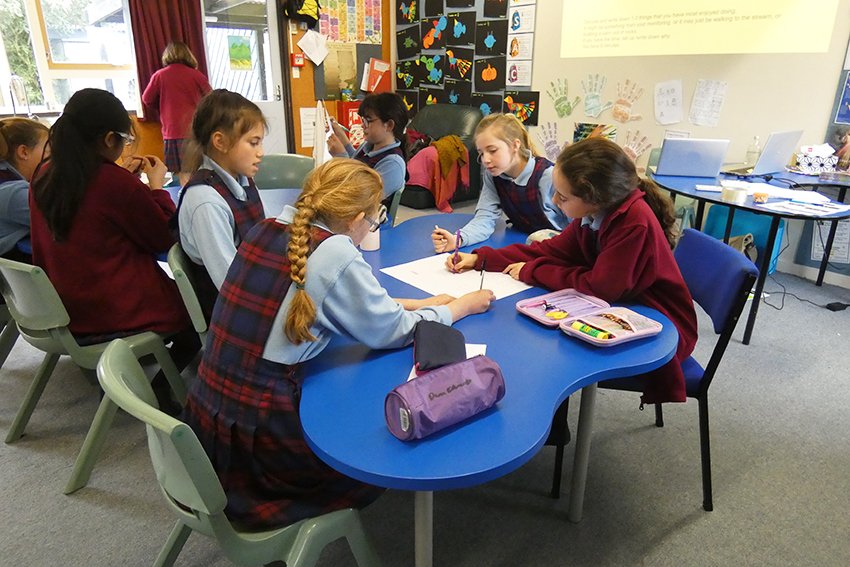
Below are some of their favourite moments and experiences:
“I like identifying the invertebrates because it’s fun to know what they are.”
“I like planting the plants because we got dirty and digging holes is fun.”
“We liked building a rock sculpture because it was fun!”
“I found a fish in a can that could have died or cut itself in the can.”
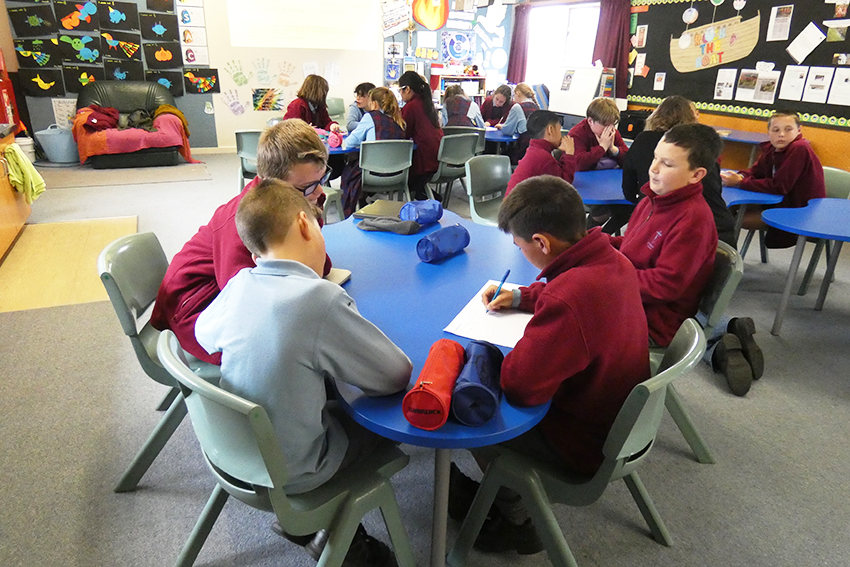
It was especially fun when we all had to “think like a fish” and imagine what a fish living in Donald’s Creek would like for the stream’s future.
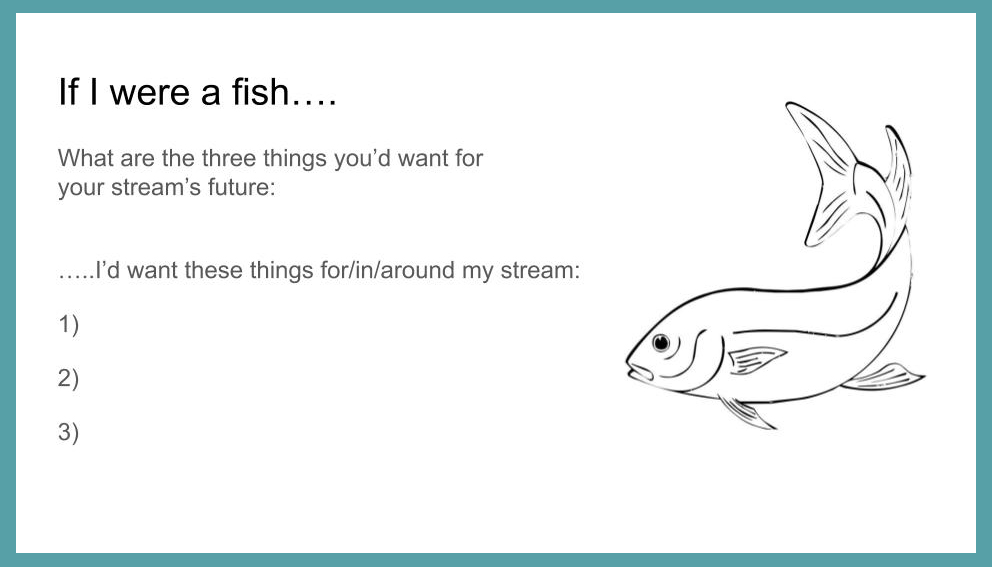
Thinking like a fish is by no means to be confused with the myth that fish have a 3 second memory. On the contrary, research on fish has been found to be able to learn new things, develop their spatial awareness, make friends and strategic alliances to hunt for food and survive if provided with the right circumstances and stimulating environments, such as rocks, plants and pebbles, where they have to find their way around the place and overcome obstacles to get food. This is quite the opposite to the standard environments provided for fish in hatcheries; dull, bare tanks where the same food pellets are dropped every day. As a result, when releasing these fish into the wild to try to support dwindling populations and eradication of species, on average, only 7 out of 100 released fish will survive.
Some of the fish’ hopes and dreams for their stream, were (to):
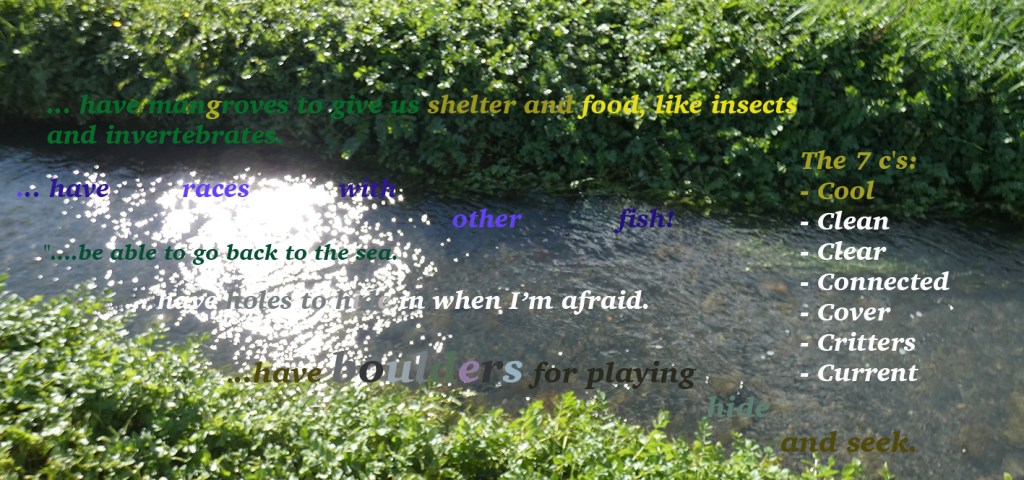
We will continue to collect, record, group and share these hopes and dreams for Donald’s Creek as we continue to work together.
Next week the student kaitiaki are going to pick one of these many ideas, hopes and aspirations, and do a drawing or a small text on it. We will also be working with found objects, plants and exploring various tools and methods around how to categorise, identify, order and present information.

 Donald's Creek Kaitiakitanga Project